


 English
 中文简体
Introduction to Portable Industrial Air Coolers As temperatures rise, keeping large spaces cool and ...
READ MORE
Best Portable Heaters for Bathrooms: A Practical Buying Guide for 2026
Content
- 1 Why Bathrooms Are the Hardest Room to Heat
- 2 What Makes a Portable Heater Bathroom-Friendly?
- 3 IP Ratings, Explained Without the Jargon
- 4 The Main Types of Portable Heater, Compared
- 5 How Many Watts Does a Bathroom Actually Need?
- 6 Safety Rules That Actually Matter
- 7 Portable Heater Options Built for Humid Rooms
- 8 What It Costs to Run a Bathroom Heater
- 9 For Distributors, Importers and Private-Label Brands
- 10 Frequently Asked Questions
Bathrooms are the awkward room of home heating. They are small, they are tiled, they are usually used for ten minutes at a time, and they are the one place in a house where water and electricity share the same air. That combination is exactly why so many people go looking for a portable heater they can carry into the bathroom on a cold morning, and exactly why so many of those searches end with the wrong unit sitting on a damp floor. This guide explains what genuinely makes a portable heater suitable for a bathroom, how splash ratings and wattages work in practice, how each heater type behaves in a humid room, and what it actually costs to run one.
Why Bathrooms Are the Hardest Room to Heat
A bathroom has almost none of the things that help a living room stay warm. There is no carpet, no sofa, no curtains and very little soft furnishing to hold heat. Instead there are tiles, glass and ceramic, all of which soak up warmth and release it slowly. A typical bathroom also has one of the smallest air volumes in the home, which sounds helpful until you remember that an extractor fan can replace that entire volume of air in a few minutes.
Heating a bathroom is therefore less about keeping it warm all day and more about putting warmth into the room fast, exactly when it is needed. That is the single most important idea behind choosing a portable heater for a bathroom, and it shapes everything else: the type of heating element, the wattage, and how quickly the unit reaches full output.
Where the heat disappears
- Tiled walls and floors absorb warmth and give it back slowly
- Small air volume heats quickly but also cools quickly
- Extractor fans push warm air outside and pull cold air in
- Short use windows demand instant rather than gradual warmth
- High humidity rules out unprotected electrical appliances
What Makes a Portable Heater Bathroom-Friendly?
Almost any portable heater will warm a room. Very few are designed to do it in a room where the air is damp, the floor may be wet, and the appliance is often placed within arm's reach of a shower. The six points below are what separate a heater that is merely portable from one that is genuinely suited to a bathroom.
Splash protection
The single most important feature. Look for an IP rating of at least IP21, and preferably IP23 or IP24 for shower rooms.
Fast warm-up
Infrared emitters warm skin and surfaces within seconds. Fan-driven heaters take around half a minute to make a difference.
Cool-touch housing
Bathrooms leave little clear floor space, so the outer casing should stay cool enough to brush against safely.
Stability and tip-over cut-off
A heater that switches itself off the moment it tilts is essential on a floor that may be slippery.
Manageable noise
Fan noise is fine in a shower room, but a quiet ceramic or mica unit suits a bathroom next to a bedroom.
Realistic placement
Cable length, a wall bracket or a hook matters more than most buyers expect in a narrow bathroom.
IP Ratings, Explained Without the Jargon
An IP rating is a two-digit code. The first digit covers dust and solid objects; the second digit covers water. In a bathroom, the second digit is the one that matters, and it is the number manufacturers rarely mention unless a product was actually built for humid rooms.
| IP rating | What it resists | Where it belongs |
|---|---|---|
| IP20 | No water protection | Dry rooms only |
| IP21 | Vertically falling drips | Bathrooms, kept well away from water |
| IP23 | Water sprayed up to 60 degrees from vertical | Bathrooms and shower rooms |
| IP24 | Splashing water from any direction | The safest choice for humid bathrooms |
One practical point that is often missed: an IP rating describes resistance to splashes and spray, never to immersion. No portable heater should ever be placed where it could fall into a bathtub, a basin or a bucket of water.
The Main Types of Portable Heater, Compared
The chart below compares how quickly each type delivers noticeable warmth. Infrared emitters, halogen and carbon alike, do not heat the air first; they warm surfaces and skin directly, which is why they feel almost instant in a small tiled room. Fan-driven heaters warm the air itself, which takes slightly longer but spreads more evenly around the space.
Each type also behaves differently once the room is warm. Infrared and quartz units stop being useful the moment you step out of their beam, which is fine for a five-minute shower but less useful if you want the room to stay comfortable while you dry your hair. Fan heaters circulate warm air and keep the whole room at a steadier temperature, at the cost of a constant background hum. Mica and oil-filled radiators are silent and hold their heat for a while after switching off, but they are rarely built with any water protection, so they usually belong in the hallway rather than beside the bath.
How Many Watts Does a Bathroom Actually Need?
Bathrooms are small, so the numbers are far lower than most people expect. Oversizing a heater wastes electricity and can make a compact room uncomfortably hot within minutes, while an undersized unit runs at full power and still feels weak.
Up to 4 sq m
500-750 W
500-750 W
4-8 sq m
1000-1500 W
1000-1500 W
8-12 sq m
1500-2000 W
1500-2000 W
Open plan or ensuite
2000 W and above
2000 W and above
A useful rule of thumb for a bathroom is roughly 100 watts per square metre of floor area, plus a margin for how quickly you want the room to reach temperature. Because a bathroom is normally heated for ten to twenty minutes rather than all evening, a higher wattage used briefly usually costs less than a lower wattage left running for an hour.
Safety Rules That Actually Matter
Most bathroom heater accidents come from placement rather than from faulty appliances. These seven rules cover the vast majority of real-world problems.
- Keep the heater at least 60 cm away from the bathtub, shower and basin, and never place it where it could be knocked into water.
- Remember that fixed socket regulations vary by country. Many national wiring rules require sockets to sit well outside the bathroom, which is one reason portable heaters are so common in these rooms.
- Never rest a heater on the rim of a bathtub, on a basin or on a wet floor mat.
- Never cover the unit with a towel, and never use it to dry clothes.
- Choose a model with tip-over protection and an automatic overheat cut-out.
- Plug into a socket protected by a residual current device or ground fault circuit interrupter wherever local rules allow it.
- Avoid extension leads in a bathroom. If one is unavoidable, keep it completely out of the splash zone and off the floor.
Portable Heater Options Built for Humid Rooms
If you are shopping on behalf of a household, a distributor or a retail brand, the shortlist below shows how three different approaches solve the same problem: getting warmth into a wet room quickly and safely.
1. Splash-resistant infrared: the FJCH16 carbon heater
Carbon infrared emitters are the natural first choice for a bathroom because they deliver heat within seconds and warm people rather than air. The FJCH16 carries an IP23 rating, which means it is built to withstand water sprayed at an angle, the exact condition created by a shower head in a small room. It is the type of heater that makes sense above or beside a vanity, pointed towards the space where you actually stand.
 FJCH16 IP23 Carbon Infrared Bathroom HeaterIP23-rated carbon heater with 450W and 900W settings, offering fast directional warmth with overheat and tip-over protection.View Product →
2. Fast circulating warmth: the HFH803S 2000W fan heater
Where the bathroom is larger or the heater needs to serve a whole room rather than one spot, a fan heater is more practical. The HFH803S is a 2000 watt portable unit aimed at small rooms, moving air through the space so the tiles and the air itself warm up together. It suits an ensuite or a family bathroom where several people use the room in sequence, and it is best placed on a dry section of floor well away from the water.
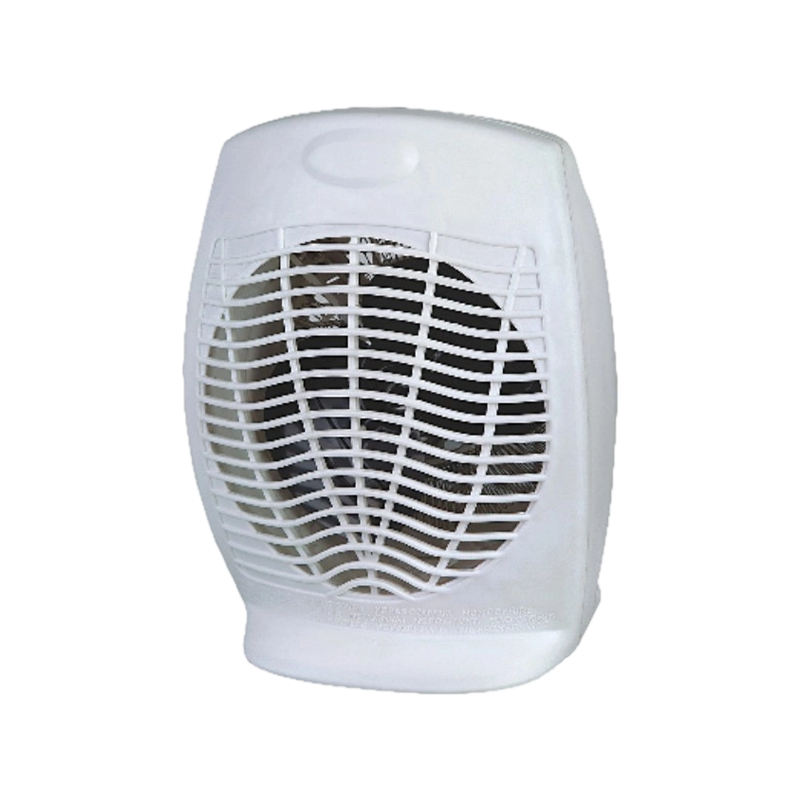 HFH803S 2000W Portable Fan HeaterPortable 2000W fan heater with 1000W and 2000W settings, cool blow, adjustable thermostat, and overheat protection for small rooms.View Product →
3. Compact ceramic warmth: the FJPTC06A mini PTC heater
Ceramic PTC elements heat up quickly, run without a visible glow and stay relatively quiet, which makes them a good fit for a small bathroom next to a bedroom. The FJPTC06A is a mini format unit designed for tight spaces, sitting neatly on a shelf or counter far from the splash zone and delivering concentrated warmth to a compact room.
 FJ-PTC-06A Mini PTC Ceramic Fan HeaterCompact 1500W PTC ceramic heater with 750W and 1500W settings, cool/warm/hot modes, oscillation, and tip-over protection for tight spaces.View Product →
What It Costs to Run a Bathroom Heater
Running costs are easier to judge once you separate power from time. Bathroom heaters are almost always used in short bursts, so the total consumption per shower is small even at high wattage. The figures below assume an electricity price of about 0.15 per kilowatt hour and are easy to recalculate for your own tariff.
0.5 kWh
500 W for one hour
1.0 kWh
1000 W for one hour
1.5 kWh
1500 W for one hour
2.0 kWh
2000 W for one hour
In practice, a 1500 watt heater used for twenty minutes consumes 0.5 kilowatt hours, and a 2000 watt heater used for fifteen minutes consumes the same. That is why matching wattage to the size of the room, switching the unit off the moment the room is warm, and choosing a fast-acting type such as infrared or ceramic matters far more than chasing a lower nominal wattage.
For Distributors, Importers and Private-Label Brands
What buyers ask us most often
- Which models carry a genuine splash rating rather than a marketing claim?
- How do infrared, ceramic and fan heaters compare in certification cost?
- Can the housing, colour and logo be customised for a retail programme?
- What minimum order quantities apply across a mixed container?
Portable bathroom heating sits at the meeting point of two product families: personal heaters and splash-resistant outdoor style units. Manufacturers who build both tend to have an advantage, because the housing, sealing and switching components overlap heavily.
Our own production covers fan heaters, ceramic PTC units, carbon and halogen emitters, quartz tubes and oil-filled radiators, with models configured for European compliance and private-label programmes. If you want to understand the mechanics first, our guide on how fan heaters work and what makes them effective is a useful starting point, and the wider carbon and halogen heater range shows how splash protection is handled across different formats.
Frequently Asked Questions
Are portable heaters safe in a bathroom?
Yes, provided the unit carries a splash rating of at least IP21 and is kept well away from the bath, shower and basin. Heaters with no water protection should stay in dry rooms.
What IP rating do I need?
IP21 is the minimum for a bathroom, IP23 is suitable for a shower room, and IP24 offers the most margin against splashing. No portable heater is designed to be submerged.
Can I use an oil-filled radiator in a bathroom?
Usually not on a permanent basis. Most oil-filled radiators have no water protection and take ten to fifteen minutes to warm up, so they are better placed in a hallway or bedroom.
How many watts does a small bathroom need?
Around 500 to 750 watts for a room up to four square metres, and 1000 to 1500 watts for a typical four to eight square metre bathroom.
Do fan heaters work well in humid rooms?
They work, and they circulate warmth more evenly than infrared, but the fan draws moist air through the housing. Choose a model with a proper splash rating if it will sit close to the shower.
Can a heater replace a bathroom extractor fan?
No. A heater raises the temperature, but ventilation is what removes moisture and prevents mould. The two serve different purposes and a well-designed bathroom needs both.
The best portable heater for a bathroom is rarely the most powerful one on the shelf. It is the one that reaches full warmth in under a minute, carries a genuine splash rating, stands steadily on a wet floor without tipping, and can be switched off the moment you step out of the shower. Get those four things right, match the wattage to the size of the room, and a small bathroom stops being the coldest corner of the house.
PREV:No previous article
NEXT:Choosing the Best Heater for a Two Car Garage: Sizing, Types, and Safety
NEXT:Choosing the Best Heater for a Two Car Garage: Sizing, Types, and Safety
Interested in cooperation or have questions?
News
-
-
An electric fan heater is a popular device used to provide quick and efficient warmth in smaller spa...
READ MORE -
1. Exploring Fan Heaters: Efficient Heating Solutions The Basic Definition and Working Principle of ...
READ MORE -
Introduction to Tea Bar Machines What is a Tea Bar Machine? A tea bar machine represents a profound ...
READ MORE
- Add:
No. 1408, Guanfu Road, Fuhai Town, Cixi City, Ningbo City, Zhejiang Province, China. - Email:
sales@fsdomy.com - Tel:
0086-574-63567602 - Phone:
+86 13805816547
-
Get In Touch
-
Quick Links
Home Products About Us FAQ News Contact -
product Center
Electric Heater Water Dispenser Air Fan & Cooling Spare Part -
NEWS & INSIGHTS
Company News Instury News -
Follow
